- Posted on
- • Uncategorized
Building Game-Engine-Agnostic Tool Ecosystems
- Author
-
-

- User
- admin
- Posts by this author
- Posts by this author
-
I’ve long been fascinated by the idea of game-engine-agnostic tools and pipelines — an ecosystem of interconnected tools that behave consistently across multiple production environments.
During my time at a studio that operated with multiple game engines, I had the opportunity to help build toolsets designed to deliver identical functionality, interfaces, and user experiences regardless of the engine in use. The goal was simple: provide artists and designers with a seamless workflow so they could move between ecosystems without having to relearn the tools every time.
Houdini Engine offers a solid foundation for this kind of cross-engine interoperability. Leveraging the HAPI protocol, it’s possible for tools to detect the environment they’re running in and automatically adjust their behavior and features accordingly. This opens the door to a powerful concept — a truly “one tool for all engines” paradigm, where efficiency and consistency coexist across diverse development pipelines.
The concept is simple.
First, detect which game engine your tool is being run in, then adjust the context accordingly.
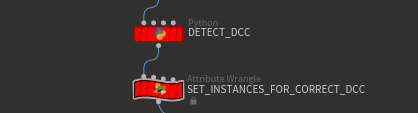
As part of your node tree, in python DETECT DCC:
import os

node = hou.pwd()
geo = node.geometry()

client_name = os.environ.get('HAPI_CLIENT_NAME', '').lower()

geo.addAttrib(hou.attribType.Global, "client_name", "")
geo.setGlobalAttribValue("client_name", client_name)
then perform your context-specific operations. In this case, grabbing an existing attribute name called 'instance' and setting the attribute name to be whatever attribute name the game engine is compatible with. In Houdini VEX:
string client_name = detail(0,"client_name",0);
string new_attrib_name = client_name + "_instance";
string output_name = client_name + "_output_name";


string instance_value = s@instance;
string extract = split(instance_value, "/")[-1];

if (extract[-1] == "'") {
    extract = split(extract, "'")[0];
    }

extract = extract + "_" + itoa(@ptnum);

setpointattrib(0, new_attrib_name, @ptnum, instance_value, "set");
setpointattrib(0, output_name, @ptnum, extract, "set");


removepointattrib(0, "instance");
The entire thing should take at minimum two nodes to build context-specific operations that'll adapt to whatever engine the tool is being run in: